BIOLOGY PHYSICS CHEMISTRY

Have the NCERT textbook open. Read it paragraph by paragraph. Then read the corresponding sentence in this blog. You'll know what I mean
Showing posts with label Structure of Atom. Show all posts

Saturday, July 4, 2009

Radioactivity and Radioactive Elements

Henri Becqueral observed that certain elements emit radiation on their own. This phenomenon is known as radioactivity. And such elements are called radioactive elements.
Other scientists in this field include Marie Curie, Piere Curie, Rutherford and Fredrick Soddy.

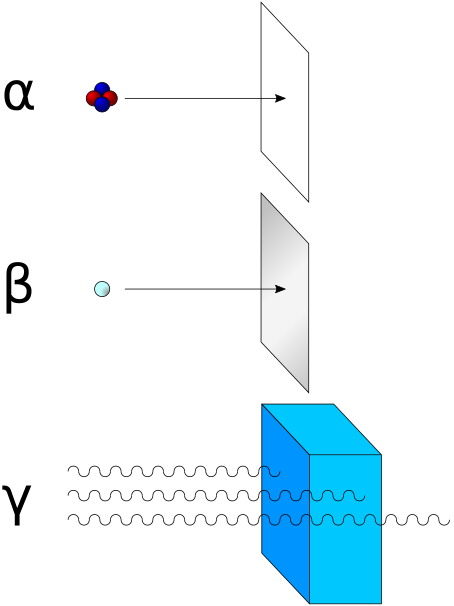
α-rays = 2 protons +2 neutrons
β-rays = -ve particles (electron or positron)
γ-rays are electromagnetic radiatons of very high energy (do not contain particles)
α-rays have the least penetrating power. β-rays have a penetrating power 100 times that of α-rays.
And γ-rays have 1000 times that of α-rays

X-rays

When electrons strike a material in the CRT, rays are produced which can cause fluorescence in fluorescent materials. These were called X-rays by its discoverer (Wilhalm Roentgen)(1895)
X-rays are produced effectively when electrons strike dense metal anode (called targets). These are not reflected by electric or magnetic fields (but they possess electro-magnetic character) and have very high penetrating power.
Wavelength = ~0.1 nm

Thomson Model of Atom

JJ Thomson proposed in 1898 that atom was spherical (radius approximately 10-10 m). That the positive charge was uniformly distributed in this sphere. And that the electrons were embedded in it like the plum in pudding, in such a manner that the atom is in a stable electrostatic state.
It is called plum pudding, raisin pudding or watermelon model.
Mass of the atom was assumed to be uniformly distributed over the atom (Rutherford said it to be localized in nucleus)

Thomson got Nobel in 1906 not for this no non-sense model (which not only helped in explaining the neutrality of the atom, but is also accepted as a standard for computational models involving spherical systems like golf balls, global weather models, and biological viruses), but for his investigations on the conduction of electricity by gases.

Neutron

Discovered by Chadwick (1932) by bombarding a thin sheet of beryllium (Be) by alpha particles. Thus neutral particles of mass slightly greater than protons (neutrons) were emitted.

Protons

Canal rays (rays containing positively charged particles) :
  • depend upon the nature of the gas present in the CRT. These are the positively charged ions (so, will have as many protons as the gas in the tube)
  • charge to mass ratio depends on gas
  • some particles carry a multiple of the fundamental unit of electrical charge.
  • opposite behaviour to cathode rays in electrical or magnetic field (charge different)
Proton from hydrogen was characterised in 1919.

Monday, June 29, 2009

Electron

In 1830, Michael Faraday showed that when electricity is passed through a solution of an electrolyte, chemical reactions occurred at the electrodes, which resulted in the liberation and deposition of matter at the electrodes. This suggested the particulate nature of electricity.
A Crookes tube is an early experimental electrical discharge tube, invented by British physicist William Crookes. It consists of a partially (but not completely) evacuated glass cylinder of various shapes, with two metal electrodes at either end. When a high voltage is applied between the electrodes, current starts flowing through a stream of particles traveling in straight lines from the cathode to the anode. These were called cathode rays or cathode ray particles.
If the anode is perforated, and the anode end of the tube is coated with phosphorescent material zinc sulphide, a bright spot on the coating is developed (which is the principle in tv sets too).
  1. Cathode rays start from cathode (-ve) and move towards anode (+ve)
  2. These are not visible themselves. But fluorescent and phosphorescent materials glow when hit by them.
  3. These rays travel in straight lines in the absence of electrical or magnetic field.
  4. In their presence, they travel like negatively charged particles (suggesting that these contain -ve particles, electrons)
  5. The characteristics of cathode rays do not depend upon the material of electrodes and the nature of the gas present in the cathode ray tube.
Charge to mass ratio:
In 1897, J J Thomson (British physicist) measured the ratio of electrical charge (e) to the mass of electron (me) by using CRT and applying electrical and magnetic field perpendicular to each other as well as to the path of electrons. Thomson argued that the amount of deviation of the particles from their path in the presence of electrical or magnetic field depends upon:
  1. the magnitude of -ve charge on the particle (directly proportional to deflection)
  2. mass of the particle (inversely proportional to deflection)
  3. the strength of the electrical or magnetic field (directly proportional to the deflection)
Thomson calculated
e/me = 1.758820 × 10¹¹ C kg -1
where me is the mass of the electron in kg and e is the magnitude of the charge on the electron in coulomb (C). Since electrons are negatively charged, the charge is -e.

Charge on electron:
RA Millikan devised oil drop experiment to determine the charge.
He found −1.6×10⁻¹⁹ C as the value. The present value is −1.6022×10⁻¹⁹ C.
The mass of the electron therefore is
me = e/(e/me) = −1.6022×10⁻¹⁹ C / 1.758820 × 10¹¹ C kg -1 = 9.1094 × 10⁻³¹ kg

Structure of Atom

The existence of atoms has been proposed since the time of early Indian and Greek philosophers (400 BC). It was thought to be indivisible and therefore called atom derived from the Greek word 'a-tomio' which means uncut-able or non-divisible
John Dalton (British school teacher) proposed atomic theory of matter on scientific basis in 1808.